Central Health’s Partnership with FarmShare Is Providing Impact in the Eastern Crescent
October 17, 2025
The nonprofit piloted a ‘Fresh for Less Mobile Market’ at the Central Health Southeast Health & Wellness Center. It now has four markets across the Central Health system.
When Laura Belew beat cancer for the second time, she really began to focus on the food she was putting inside her body.
“Before, I wasn’t as concerned about whether things were organic,” she said. “Now, I’m really concerned about it.”
The only problem? In her pursuit of that goal, there’s often been a pressing and seemingly unsolvable issue: buying food. That’s because Belew lives in Hornsby Bend, an unincorporated area in Eastern Travis County with about 12,000 people but with no grocery store. According to the U.S. Department of Agriculture, residents of Hornsby Bend and nearby Del Valle, located about six miles south, are smack dab in a food desert.
In rural and low-income parts of Travis County, food deserts are of great concern. They’re neighborhoods, often entire regions, where it’s hard to find fresh and healthy food like fruits and vegetables. Grocery stores are scarce, and public transportation is limited. Instead, residents may have to rely on convenience stores or fast-food restaurants for meals. Over time, that lack of access contributes to higher rates of diet-related illnesses such as diabetes, high blood pressure, and heart disease.
“The food supply has always been really challenging,” said Belew, who first moved to Hornsby Bend in 2000.
The consequences of living in a food desert have been dire. Statistically speaking, per Central Health’s demographic reporting, people living east of Interstate 35 have been diagnosed with chronic health conditions in greater numbers than the rest of the county, and many face life expectancies up to 10 to 15 years shorter than those living west of the freeway.
In real-world terms, food insecurity means people don’t always know where their next meal will come from or can’t afford enough nutritious food for everyone in their household. According to the Food and Agriculture Organization of the United Nations1, food insecurity spans a spectrum of needs, from food availability to food access to utilization to stability. Texas has the second highest prevalence of food insecurity in the nation. Hornsby Bend and Del Valle exemplify that fact with stark numbers—more than 17% of residents in those areas, or about 3,800 residents, are food insecure.
To combat this, in late 2024, the Austin City Council and the Travis County Commissioners Court approved a multi-level food plan. Central Health, meanwhile, has been busy preparing innovative ‘Food is Medicine’ programs of its own.
Finding Short-Term Solutions
For decades, residents of this area within Del Valle and Hornsby Bend, which is known as the Eastern Crescent, have been pleading with retailers for a grocery store. The nearest one is about 10 miles away from Del Valle or Hornsby Bend. Ten years ago, a grocery chain bought a plot of land near Austin-Bergstrom International Airport. The theory was that a grocery store might be built to serve the community at large. But in late 2024, the chain sold it back to a developer and planned another store in a different part of East Austin.
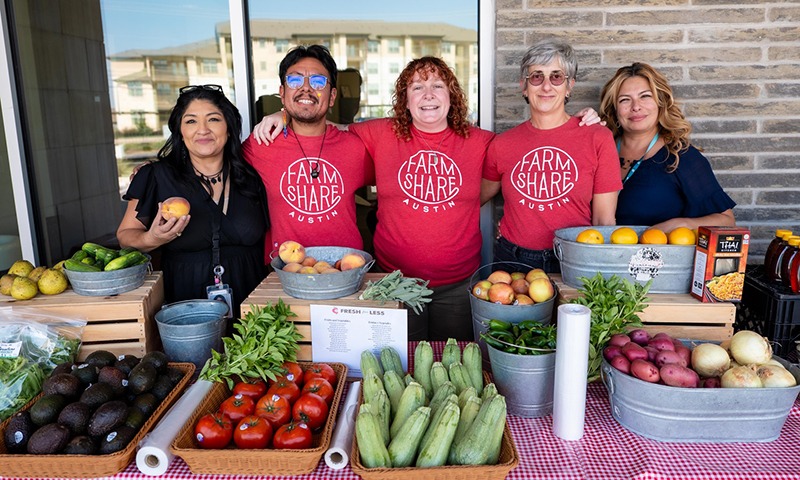
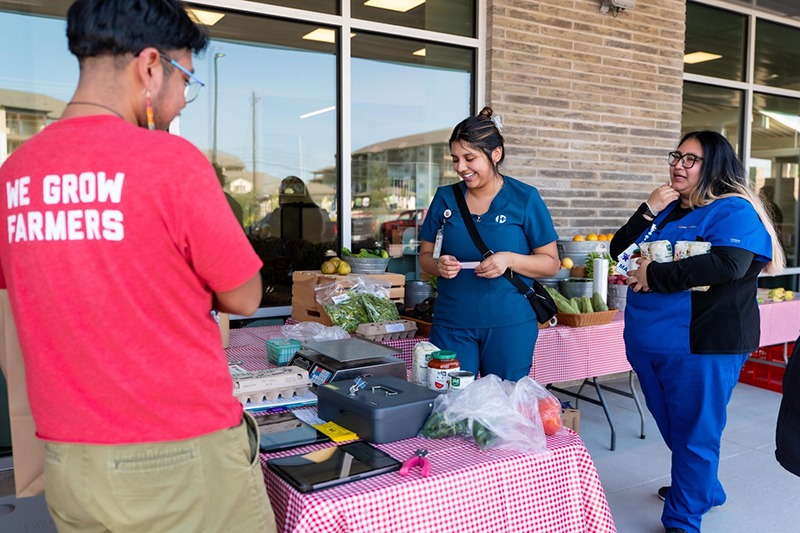
As a result, interim solutions have been necessary. Two years ago, when Central Health’s Hornsby Bend Health & Wellness Center opened its doors, a small slice of change came. In May 2024, Central Health signed a contract with local nonprofit FarmShare Austin to bring its ‘Fresh for Less’ program to Hornsby Bend residents—though the organization first brought its mobile markets to the area in 2016. Once a month on Fridays, community members, including people enrolled in the Supplemental Nutrition Assistance Program (SNAP), could buy local fresh food grown from local farms, along with shelf stable (packaged) and canned goods through mobile markets held by FarmShare Austin. For those unable to find transportation or were mobility impaired, the organization provided access to a home delivery option, a resource first born in 2020. All of this would be provided at a reduced cost.
“That’s money well spent,” Belew said. “Because it’s helping this population be healthier.”
Each year, FarmShare executive director Andrea Abel says, the nonprofit serves about 9,000 customers across 442 square miles in 25 zip codes. Together with Central Health, the organization has been able to extend its reach.
“It’s been really fulfilling to partner with Central Health,” Abel said. “We think partnerships with Central Health and local FQHCs (Federally Qualified Health Centers) are helpful and successful because of that shared health and wellness mission.”
The Origins of ‘Fresh for Less’
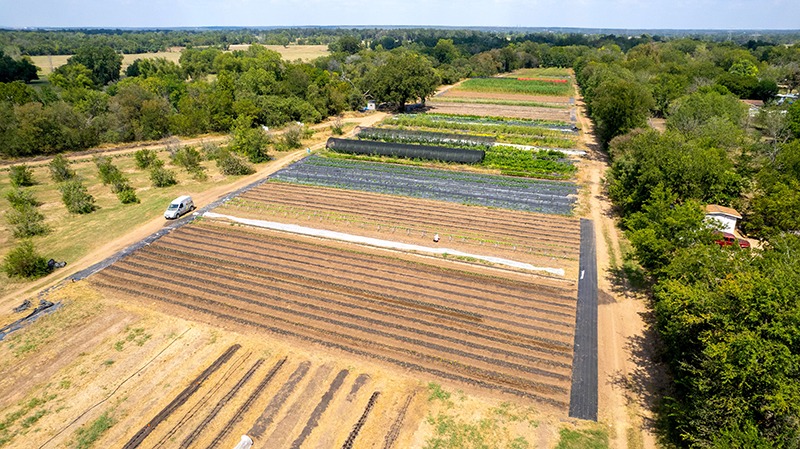
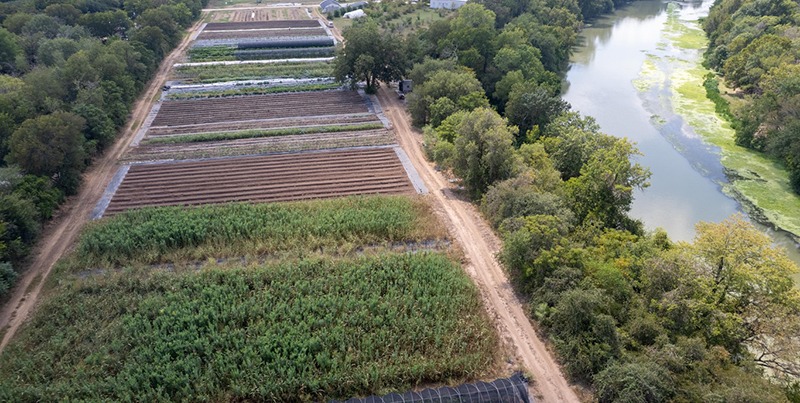
Twenty miles east of Austin, sandwiched between the Travis and Bastrop County lines and nestled along the Colorado River, lies 13 acres of certified organic farmland operated by FarmShare Austin. Thousands of crops have bloomed through the seasons, each springing to life from the rich soil. “We plant things with nice, good roots,” said Alicia Fischweicher, the nonprofit’s food access director.
From sweet bell and spicy peppers to aromatic basil, bok choy, and eggplant, the food grown here has direct ties back to Travis County, feeding thousands of people with food insecurities. “Sixty-seven percent of what we are sourcing is local, which accounts for 89,000 units,” Fischweicher said, “so we’re sourcing a lot of local food.”
Since 2014, FarmShare Austin has developed future farmers in Central Texas and helped provide greater access to food deserts in the region, specifically in the Eastern Crescent. The community-based food access program, first piloted in 2016 by FarmShare and beginning at Central Health’s Southeast Health & Wellness Center in 2017, is directly providing impact across Eastern Travis County. And with Central Health’s focus in 2026 centering around the ‘Year of Access’—with operational goals to shorten wait times, create a connected system, and deliver maximum value—developing a pipeline for high-quality, nutritious, and accessible food remains an important mission for Central Health.
“There are huge gaps in food access in Austin and Travis County, and as it gets more expensive to live in the city core, people are moving farther out in areas that don’t have resources,” Abel said, “so we focus on zip codes that have the highest barriers to food access.”
FarmShare Austin operates mobile markets across four health centers within the Central Health system every month (among a few other locations it serves in Travis County): the first Tuesday at CommUnityCare’s North Central location; the second Tuesday in Del Valle; every Thursday at Central Health’s Southeast location; and every third Friday in Hornsby Bend.
“I think the work we’re doing is important because we try as much as possible to take a whole food-system approach to looking at farming and food access,” Abel said. “We are providing food for our community. We are supporting local agriculture, and we are teaching the next generation of farmers so we can have a truly resilient food system.”
Long-Term Health Impact
The impact of FarmShare Austin’s mobile markets has been tangible in Eastern Travis County.
Belew, who says she relies on locally sourced food to maintain a balanced diet, is a perfect example. “I’m a cancer survivor, so good food is important to me so I can continue to live,” she says. “I told myself that I would decide to use this to get closer to farms who could actually give me what I need.”
But she’s not alone. Lori Wilmott, 66, shops at Hornsby Bend’s mobile market to help feed her daughter and two kids. “It’s great to have access to real fresh food,” she said. Beth Acuna, meanwhile, has written to grocery chains to advocate for food resources in the Eastern Crescent, but until there is change, she shops at Hornsby Bend because it allows her to try new things. “It’s always nice to know if there’s something I want to try, I have that opportunity,” she said. “Like, I’ve never had beets. Let’s try beets.”
In Del Valle, Melissa Anguiano works at the Central Health Del Valle Health & Wellness Center and routinely uses the market—which is moving to once-a-week in November—to stock up on monthly needs like eggs, pasta sauce, and other items like avocados. The market is a resource she can’t find very close elsewhere, and she says it serves a greater purpose for a community in need of fresh food.
With more than 15,000 new housing units in the Austin metro area projected to be completed by December, according to a 2025 analysis by RentCafe, Travis County’s population continues to boom. Del Valle, as a result, is growing too— 943 units are scheduled to be completed by the end of the year; the fifth-most in the Austin area. Manor, which was once without a grocery store until a Walmart was built in 2014, has the second-highest rate of new apartments being built by the end of 2025 with just over 2,650.
Food access remains a pressing need in Travis County. Without a reliable grocery store in Del Valle and Hornsby Bend, Central Health’s partnership with FarmShare’s Fresh for Less mobile market is providing a reliable backbone.
“Because people need it,” said Memo Chavez, FarmShare’s food access community outreach coordinator.