From Streets to Surgery to Stability: How Central Health’s Coordinated Care Transformed One Man’s Life
August 11, 2025
Alan Kelly’s journey through two major surgeries to permanent housing shows the power of wraparound health care
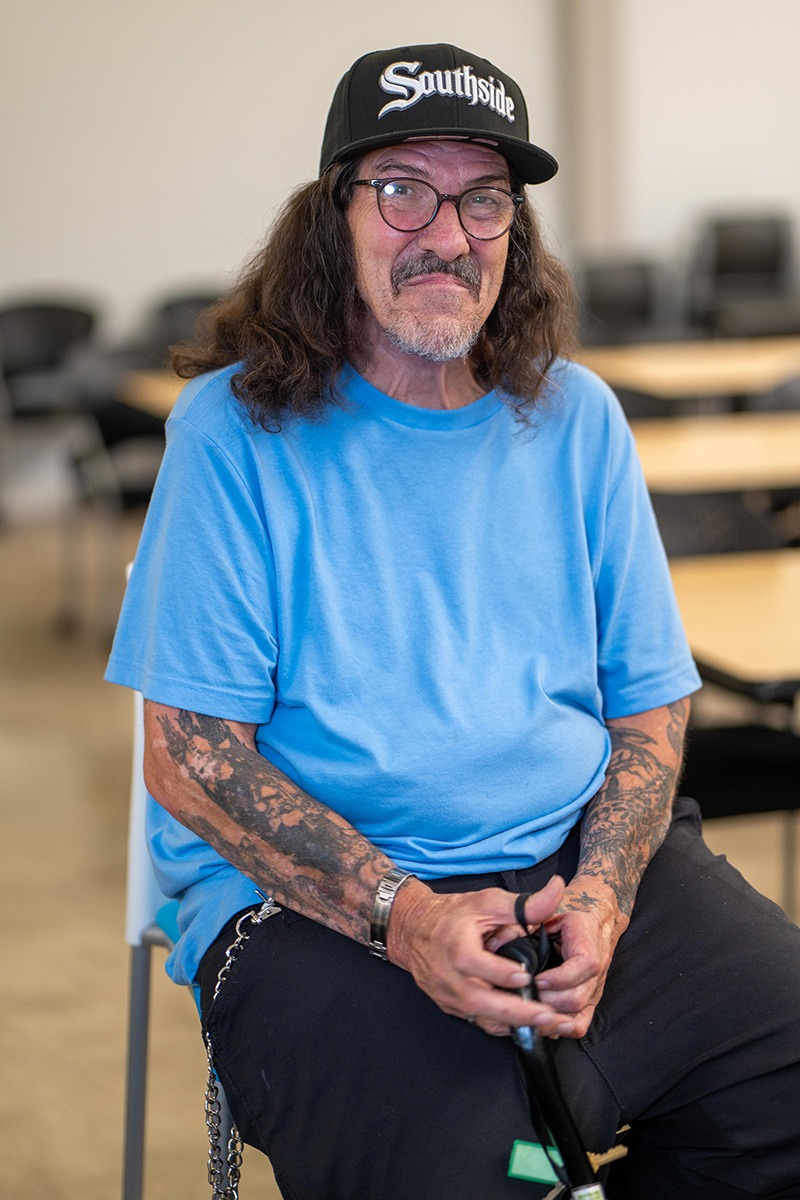
AUSTIN, Texas—Alan Kelly’s fingers began to flex inward, and his back was beginning to leave him with a numb feeling. Was it pain from a two-decades old motorcycle crash?
Living on the streets, he had various other health issues, from hip displacement to liver damage to a lifelong habit of smoking.
Kelly knew he needed serious help, so in late 2024, after a hospitalization at Dell Seton Medical Center at The University of Texas, Travis County’s safety-net hospital, Central Health admitted him to a skilled nursing facility (SNF).
“By the time I got to Central Health, I was pretty far down the ladder,” Kelly, 60, said. “When I started, I had nothing. I had absolutely nothing. I would go there and two or three (providers) would be like, ‘What do you need? What is going on? How are you doing?’”
Through a coordinated system of care, which included enrollment in Central Health’s Medical Access Program (MAP), his buy-in of comprehensive health care programs, and two major surgeries, Kelly was able to get the help he needed.
“I think the thing that Alan needed more than anything else was a place to call home, a place where he could heal and continue to connect with the medical teams and the case management teams that have supported him,” said Dr. Hemali Patel, Central Health’s director of transitions of care. “On the journey to getting home, the Central Health teams have done an amazing job of supporting him.”
Breaking the Emergency Room Cycle
Kelly’s success was due in no small part to acknowledging his situation, taking responsibility for his health, and lots of hard work. His previous life on the streets included multiple emergency department (ED) visits, sometimes just to quell aches and pains.
“I asked (Central Health) up front, ‘If you give me some place to stay that’s clean and I can get better, I’ll do everything the program has me do,’” Kelly said.
Surgery and Sobriety
Central Health’s plan focused on redirecting, when appropriate, his ED visits toward other ambulatory medical care settings better suited to meet his needs. But Kelly needed surgery first. And to get surgery, he needed to stop smoking.
His surgeon at Dell Seton Medical Center, aligning with standard practice for optimal healing and post operative recovery, told him he wouldn’t operate unless he quit. Over eight months, through integrated care and oversight from the Central Health system and its providers, Kelly worked toward that goal.
“I had been fighting the tiger for a minute,” said Kelly, who enrolled in multiple programs offered by MAP, a health care option for Travis County residents with low income, during this time.
Once he gave up tobacco, Kelly was able to successfully undergo the first of two major surgeries, including a procedure in 2024 on his spinal cord. He said his surgery helped alleviate the nerve damage which was impacting his range of motion—issues that could have eventually led to paralysis, he added.
In the interim, he was in constant contact with the Central Health team, including his case managers, and the CommUnityCare Care Connections Clinic on South First Street.
Recovery and Wraparound Care
Kelly had no place to go and needed a place to heal from his back surgery. To give him that safe, nurturing space, Central Health’s high-risk populations team enrolled him in MAP’s medical respite program.
Welcoming wrap-around support from a versatile team, including physicians, case managers and community health workers, he began to regain his health.
“I think Alan is like a lot of our patients, in that we see people who need second, third and fourth chances, and he’s a great example of what these chances can mean for someone,” Dr. Patel said. “He has been a part of many different, complex, traumatic experiences, but he’s always demonstrated his desire to pursue what’s best for him, and he’s been supported by the right people who have motivated him.”
A Groundbreaking Partnership
His respite stay ended with Kelly, who was temporarily disabled, enrolling in a groundbreaking program between the Transitions of Care department and Parsons House Austin, an assisted living community providing access to health care coordination, wellness checks, and medication management.
The assisted living community offers short-term, concierge-level residential rooming services for Central Health patients seeking long-term housing solutions. Kelly was the first patient admitted in Central Health and Parsons House Austin’s collaboration.
“During his time in the program, Alan not only recovered physically, but he found friendship, support and a renewed sense of purpose,” said Cameron Parsons, the CEO of Parsons Group (dba Parsons House).
Kelly’s second surgery to correct his hip displacement was scheduled in March during his final month at the assisted living community.
By then, he had been approved for housing, too.
From Temporary to Permanent: Securing Housing
After 90 days at Parsons House Austin and a successful hip surgery, Kelly secured permanent supportive housing through a voucher with the Housing Authority of the City of Austin (HACA).
CommUnityCare SOAR (SSDI, Outreach, Access, and Recovery) case manager Ashley Villodas worked with Kelly to secure a permanent place of housing, while Krystal Fuentes, a disability application specialist with Central Health, worked to gain Supplemental Security Income, along with Medicaid coverage, which provided financial support.
“The window opens,” Kelly said of his chance opportunity to receive housing, “and ‘Bam,’ my name goes right in. I earned a spot right then and there.”
Today, Kelly, who’s walking again, continues to recover fully from hip surgery in part through occupational and physical therapy that is covered through Medicaid. He says he’s grateful for every opportunity that has come his way.
“(Central Health) put me in the right position to get the things I needed without an issue,” he said.
Kelly continues to focus on his health and is taking additional steps to get back on his feet.
“Central Health helped me get my life back together, get my feet back on the ground and get a forward motion that I can work with,” Kelly said. “That’s what Central Health did for me.”