Four New Voices, One Shared Calling
July 17, 2026
Central Health’s newest Community Health Workers turned their own life stories into a bridge for others
They came to health care from different points in their lives: from the military, fitness industry, secondary education, and the many responsibilities of life.
Then, after an accelerated Central Health training program, a group of four Travis County residents became Community Health Workers (CHW). In July, Matthew Rodriguez, Alexia Campbell, Nohea Tumale and Melanie Neri were the second graduating class from Central Health’s full-time 13-week apprenticeship program.
“Knowing there are individuals who can connect people with resources who don’t have them,” said Tumale, a former manager in the fitness industry, “it fires me up. I was glad to be a part of this.”
Understanding The Role
In health care, CHWs strengthen patients’ connections to the things they need for good health and provide access to resources they might not be looking for or even know about. They work as liaisons between the community and the health care system. And they’re integral toward creating positive health outcomes.
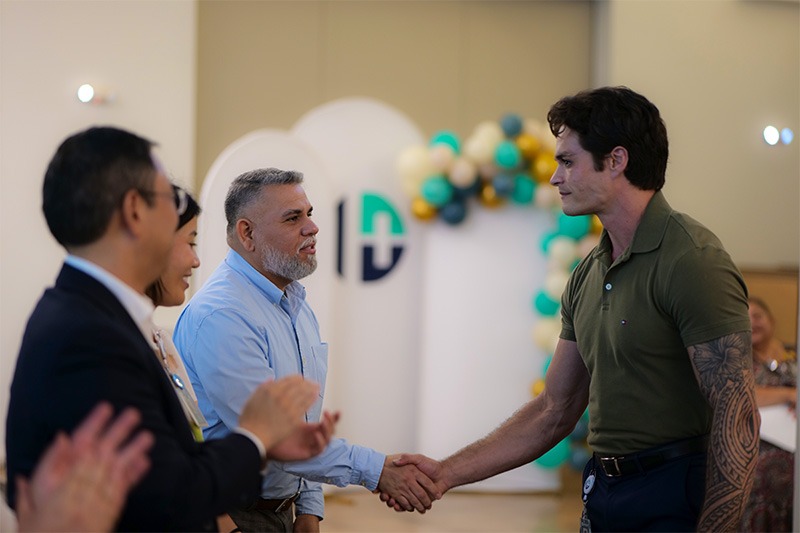
This role is vital, because CHWs often enter a patient’s journey at their most important juncture—as care coordination must be navigated; as preventative health care options must be discussed; and as transitional moments in the health care continuum should be managed.
Central Health’s long-term vision for the Community Health Worker Training Program is to deliver more help to the system and provide care for people with limited or no access to it.
As workforce shortages in health care continue to pile up, programs like this one have served to shore up gaps and redevelop the pipeline.
“Central Health has recognized the importance of CHWs and has chosen to invest in this,” Central Health Director of Education and Research Carol Wang, PhD, said.
Central Health’s 13-week apprenticeship culminates with students earning their CHW certifications.
Real Life Lessons
Years ago, while working as a preventative medicine specialist in the Army, Matthew Rodriguez was providing humanitarian assistance to the people of a small Honduran village when a huge storm swept in.
His team was forced to stay that night.
“The mayor of the town got all the townspeople together, and they gave us rolled-up mattresses,” he said. “They cared that we had a place to lay down and food to eat.”
Rodriguez (who remains in the Army reserves) never forgot the experience. Today, he says, it sheds light on what health care means to people without consistent access to it.
“Being able to go out and give these resources is one of the biggest things,” Rodriguez said.
Melanie Neri came to the CHW program as a substitute teacher who aspired to help people more broadly. At home, she held the responsibility of contributing to her family’s needs, and when time and finances allowed, took classes at Austin Community College.
Alexia Campbell, meanwhile, recently moved to Austin from Baltimore. With previous entry-level experience in health care, she vowed to advance her career and make a larger impact.
“I like to do work that feels important,” she said, “and where I feel like I’m making a difference.”
Nohea Tumale certainly understood that feeling, too. In a previous role managing a gym chain on the west coast, he often found joy in outreach work.
“I really wanted to work toward my goal of helping the community in a more medical way,” he said. “The CHW position fit my values perfectly for that.”
A Fulfilling Career
The Central Health system employs about 55 CHWs in total, said Ryann Neubauer, Central Health’s Community Health Worker program manager. In 2026, nine graduates have completed two cohorts of the CHW program, with a third planned for August. Most of the graduates of the program have since been hired for roles within the Central Health system. Because of the program’s success and popularity, in 2027 Central Health is planning to expand cohorts to seven students and will also be partnering with Goodwill Central Texas and Foundation Communities.
Statewide, Texas communities are seeing numbers of CHWs. Between 2023 to 2024, the amount of CHWs increased by 33%, according to the Texas Health and Human Services department.
“We know that we are wanting to expand and align our mission and make it a year of access,” said Neubauer, “and we know the best way to do that is through Community Health Workers who are people that have lived experiences.”
Over the 13-week course, Central Health’s accelerated training provided candidates with a bounty of information, compiling 320 hours of coursework on top of 200 hours of observational learning in clinical settings and at partner organizations.
Students learn about community health and disease prevention. They also learn about disparities in mental health, substance use, and environmental health. Acronyms like “SDOH,” otherwise known as social determinants of health, are memory-banked and meant to provide understanding around the non-medical challenges people face in environments that impact a person’s long-term wellbeing.
Introduction To Training
In-clinic shadowing remains one of the training’s biggest tools. Students take guidance from seasoned CHWs who walk them through practical environments: talking with patients, notetaking in Epic’s MyChart, and interacting with nurses and physicians within hospital systems.
In the last week before graduation, Rodriguez welcomed one of these lessons. Inside Dell Seton Medical Center at The University of Texas, he faced a new situation with a patient—one that offered him to think on his feet.
Cicely Gaines, a Central Health Community Health Worker with nearly a decade of experience, flanked to his right. When the moment required, she provided seamless calm.
“She knew exactly what to say,” Rodriguez said. “I wish I could have done that.”
“And you will,” Gaines added.
“You see what you can help them with. And then you see what you can do for them.”
Answering The Call
CHWs can sometimes best be described as jack-of-all-trades. They might be needed in clinical settings to help patients secure access to services. Sometimes, their assignments can take them to enrollment events to assist with documentation. They might help a person sign up for MAP (Central Health’s Medical Access Program) or MAP Basic, two coverage options for Travis County residents with low income.
CHWs might work in an administrative setting and help track programs and resources digitally. Or they may have to call patients on the phone.
Altogether, the job remains the same: connect people to care, where and when they need it. Inside the Central Health system and across health care, that role is critically important.
“There are so many resources that no one knows or talks about,” Rodriguez said. “I never realized how much help is out there. So being able to go out and give these resources is one of the biggest things.”
Connecting people to care is also why most do it.
“Growing up, my family used a lot of the resources that community health workers gave us,” Neri said. “So now this feels kind of full circle.”